Why Does Art Move Us?

Why Does Art Move Us?
On Recognition, Grief and Rothko
There are moments when language does not fail so much as withdraw. Not because the experience before us is vague, but because it is uncomfortably precise. Art, at its deepest, does not instruct or persuade. It arrives as pressure, as atmosphere, as a subtle displacement of the inner life. We leave the gallery altered, though nothing outward has changed. Something has shifted its weight within us, and refuses to settle back.
This may be the first clue as to why art moves us at all. It does not appeal to reason. It addresses something older, less articulate, and more enduring. A register of feeling that precedes explanation. We respond not because we understand, but because we recognise.
I was a teenager the first time I encountered Rothko. I did not yet know how to look at art properly. I had no theoretical equipment, no historical scaffolding. What I felt instead was unease. His paintings unsettled me in a way I could not explain. I remember standing before one of the great colour fields, its reds darkened almost to bruising, the edges blurred, uncertain, and feeling a vague disturbance, a tightening in the chest. I did not know why I could not look away, nor why I wanted to.
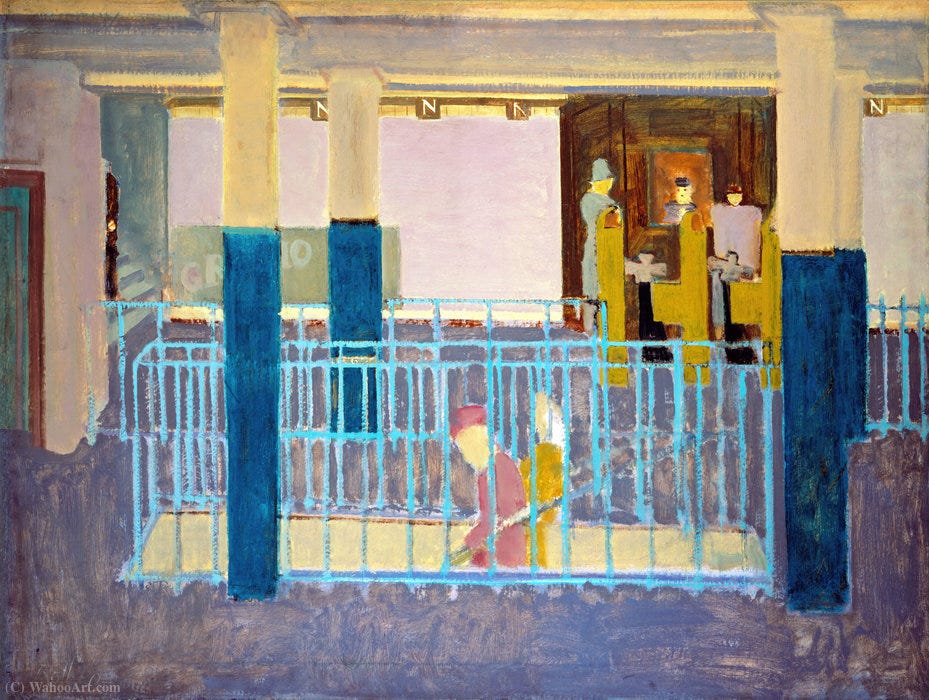
Entrance to subway 1938 Mark Rothko
At that age, I lacked the emotional language to name what was happening. I only knew that something in the painting was not decorative, not benign. It was not trying to please me. It seemed to know something I did not yet know how to say.
Later, I would learn that Rothko had not always painted this way. His early realist works, the subway scenes, the solitary figures hunched beneath harsh lights, already carried a quiet desolation. In paintings such as Subway Scene or Entrance to Subway, the human form is present, but diminished, pressed inward by architecture and anonymity. These are not portraits of modern life so much as meditations on isolation. Even then, Rothko was less interested in what people were doing than in what they were enduring.
The transitional works came next. Mythic figures. Floating shapes. A loosening of representation. In paintings influenced by Greek tragedy and archaic forms, bodies begin to dissolve, becoming symbols rather than individuals. The world thins. Meaning migrates from figure to atmosphere. Looking back now, it is clear that Rothko was shedding the visible world not out of abstraction, but necessity. He was moving toward something more exact.
By the time he arrived at the colour field paintings, the so-called classical phase representation had been abandoned entirely. And yet nothing essential was lost. If anything, the emotional pressure intensified. Works such as No. 61 (Rust and Blue) or Red on Maroon do not describe grief. They enact it. The colours hover, unstable, their boundaries soft, as though the painting itself were breathing. Standing before them, one does not observe sadness. One enters it.
As a teenager, this unnerved me. I did not have words for grief then, though I knew it intimately. I had lived with sadness long before I understood its name. Rothko’s paintings seemed to reach directly into that unspoken interior space and hold it open. This was frightening. It felt like exposure. I remember wanting to step back, and yet remaining, held in place by something like recognition.
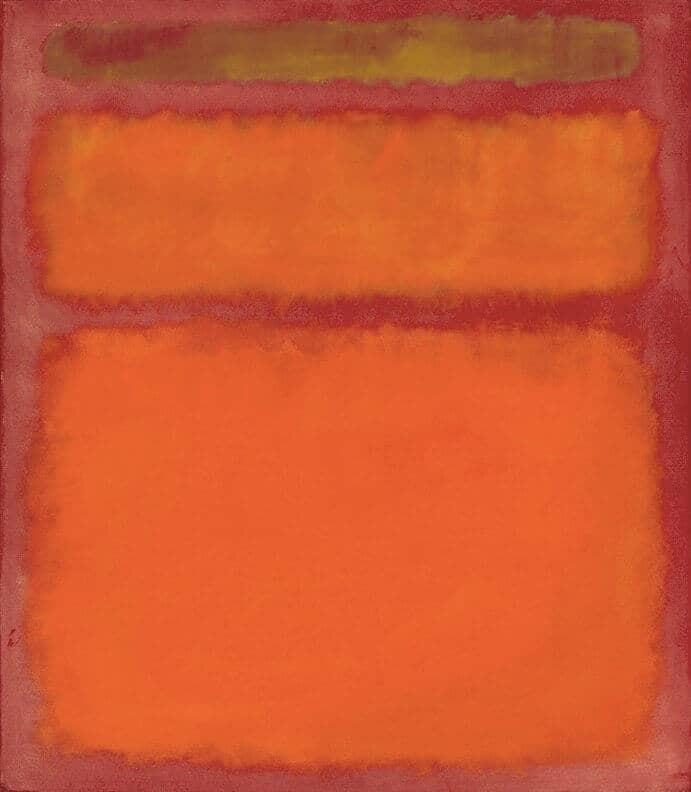
Orange, red, yellow 1961 Mark Rothko
It would take years to understand what I had sensed instinctively. That I had found an artist who understood grief not as drama, but as condition. Not as event, but as weather.
The same recognition came later, reading Anne Sexton and Sylvia Plath for the first time. Again, not admiration, but relief. The feeling that someone had articulated the unsayable without softening it. Sexton’s raw candour. Plath’s cold precision. Neither offered consolation. What they offered was accuracy. A refusal to prettify sadness or redeem it with metaphor. Reading them, I felt the same unsettling calm I had felt before Rothko. The knowledge that I was not alone in what I felt, even if that feeling remained unresolved.
This is what moves us in art. Not beauty in the conventional sense. Not pleasure. But recognition. The moment when something private is mirrored back to us with exactness. Rothko’s paintings remove our usual defences. There is no narrative to follow, no symbolism to decode. We cannot admire from a safe distance. The painting does not ask what we see. It asks what we are willing to feel.
This can be deeply uncomfortable.
Rothko understood this. He wanted his paintings hung low, close to the body, often in dim rooms. He did not want spectators. He wanted participants. His ambition was not aesthetic in the decorative sense. He spoke openly of tragedy, of human vulnerability, of art as a place where the soul might confront itself without irony.
The late works, particularly the near black paintings and the canvases of the Rothko Chapel, feel less like images than spaces one enters with caution. The darkness is not empty. It is dense, almost architectural. One feels held, and threatened, at the same time. There is always the sense that if one stayed too long, something might give way. And yet we stay.
Because art moves us precisely where language cannot escort us safely.
Before a Rothko, the body becomes newly apparent. Time loosens. Thought slows into sensation. This is not escape. It is confrontation, conducted quietly, without accusation. The painting does not tell us what to feel. It allows us to feel without defence.
This is why reproduction fails. A Rothko on a screen is a diagram of an encounter, not the encounter itself. The scale matters. The physical presence matters. The way the colour seems to advance and retreat, to breathe, matters. Art, at its most powerful, is not information. It is an event.
We leave the gallery and return to the small tyrannies of the day. And yet something remains. A residue of stillness. A heightened sensitivity. A sense that beneath the visible world, beneath language and explanation, there is a deeper register in which life continues to speak.
Rothko does not offer answers. Neither do Plath or Sexton. What they offer is recognition.
And perhaps that is why art moves us. Because, for a moment, it allows us to stand in the presence of our own grief and sadness and know, with quiet certainty, that someone else has stood there too, and understood exactly what it was to feel that way.
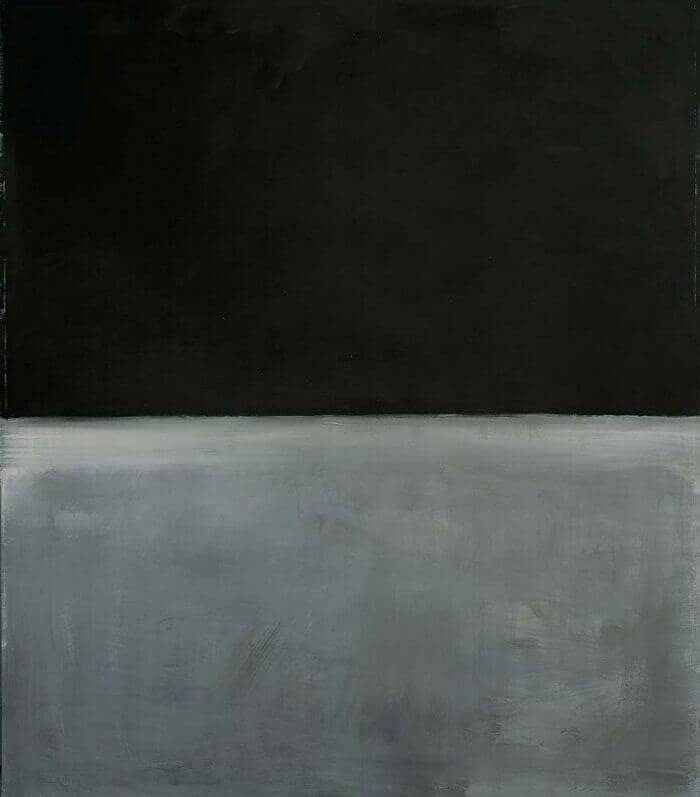
Untitled black on grey 1969-1970 Mark Rothko
I have similar sentiments regarding Dalí's work. The first time I viewed a selection of his original paintings, there was something unsettling, yet reassuring about them. His images invoked uneasiness and comfort simultaneously, kind of like when experiencing lucid dreams (which I do regularly).